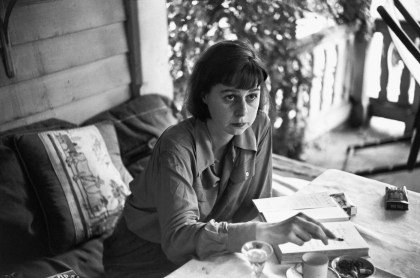
To David Diamond
Yaddo, Saratoga Springs, New York
July [22, 1941]
Tuesday
My Dear David,
It is early afternoon, and I have just drunk two glasses of sherry and prowled for a time about the room. The sky is darkening, and the trees have taken on that violent green that precedes a thunderstorm. The house is very quiet.
Your letter came this morning, and I have read it many times. It is a hard letter to answer, David. Some parts are ambiguous, and you do not altogether make clear your own feelings.
So I must start by simply telling you again how I am now. After this past year of horror I am quite calm, balanced, and in command of myself. I can work again at last. I believe that now I can accept the final loneliness without dismay. –I have thought much about Reeves, and about our marriage. When we married, David, I gave myself over with my whole heart to making our marriage a success. We lived together for a long time, Reeves and I, and the first year was a happy one. I began my book the first week we lived together—and I worked so damn hard. But then, when the book was finished, something happened. In Fayetteville there was already the tension and dissatisfaction and I went through a sort of death. Since then I have tried in every possible way to fortify that which is strained and breaking. But now I am afraid it is no use. When I live with Reeves I cannot work, and both my inward and outward lives are thrown out of gear. I am not sure, also, that I am good for him; there is a point where I can help him no longer, and he must face things out himself. –A broken marriage is a painful thing; I suffer and I know he suffers. I feel toward Reeves as though he were a young and much loved brother whom I must leave in some distress.
But enough of this, David. Don’t mention any of this to Reeves. I have told him all this in words, but there is still much to be cleared up between us.
I have stopped off for a while. The rain clouds have scattered and the sun is out. The air is rather damp and thick. You say that you want my love for you to be a much more vital and binding thing than “brotherly” love. By that I don’t know just what you mean. I do know that in the past year I have been terribly duped by people, and have given myself to those who are specious and hysterical. But that is all over. No, I don’t have many loved ones—my mother, Reeves, Muriel, —and who else besides you?
I don’t think that you meant passion. That is the last thing I want. For Annemarie I felt passion. Have you read “the Idiot” any time lately?—in my feeling toward her I was a cross between Ragozhin [Rogozhin] and Myshkin. And of course it was not Annemarie as a human being whom I loved so desperately; passion makes the beloved anonymous. Passion, also, implies the absolute impossibility of fulfilment. –Well, all that is over for me. I nearly murdered myself, and with the help of God I hope it won’t happen again.
I used to hold to the belief that it is wrong to categorize love. Love is love—just as jam is jam. But there can be blackberry jam, and spoilt jam, and fresh quince jam, and jam that has been cooked along with a few stray flies. So maybe love has to be sorted out also.
I love you, David, as I have told you. As soon as we met there was a direct and vital communication between us. Very quickly (everything happened so fast) we reached a keenly sharp emotional point. Then there was Reeves. I don’t know just what your relation is with each other. Neither of you have ever made it altogether clear to me, and I would not ask. I only sensed that there was something for me to withdraw from.
Just as I have often thought that I must withdraw from all life. I love life, I love people, and yet in some unnamable way I am put apart. There are times when I have felt like a small child shut up in a dark closet and hearing the sounds of a party going on outside. –But now, since I have been up here, I don’t beat any longer on the door. I know that I can accept this loneliness and find what I need within myself.
Just now I am not able to qualify, to define, to modulate honestly my love for you. If I could I would do so. There are times when I think that if I had never married Reeves that I would live with you—and we could make a life together. I don’t know. And that—the sharing of one’s life—is the only point beyond brotherly love that I can imagine.
But time will have to pass before many of these things can be clearly understood. And we must have the chance to be with each other more. In your letter, David, you were not clear about your own feelings toward me. You say: “No one wants it (my love for you) or needs it more than I right now.” The underscoring is mine.
I can’t write anymore. There is so much I want to say. But it would take dozens of pages, and even then I don’t think I could make myself altogether clear. I am not a complicated person. And there is so much longing in me—longing for homely things. I have been through much—but I am not frightened any more.
Of course the Ballad is for you. I work on it, getting two or three pages done every day, and it is a good fairy tale. The New Yorker bought the first little piece I sent them, and I have not yet heard from the second. I am so eager to finish the Ballad and the other long story, and hole in for the Bride.
David Dearest, take care of yourself. Don’t pick up any more colds. And do explain about your trunk that has “got away”. Trunks just don’t get away like that. It must be somewhere. Don’t worry if you don’t seem to be getting as much done as you had expected. It will come. I have such great faith and pride in you.
You can still love me if you want to.
Your,
Carson
Carson McCullers Collection, Stuart A. Rose Manuscript, Archives, and Rare Book Library, Emory University

Leave a Reply
You must be logged in to post a comment.